How to Get on the First Page of Google in X Easy Steps
We’ve talked before about the ideal client. Essentially, it’s a person (or type of person) who finds exactly what they need when they walk into the front doors of your business. A guaranteed sale.
We’ve talked before about the ideal client. Essentially, it’s a person (or type of person) who finds exactly what they need when they walk into the front doors of your business. A guaranteed sale.
In layman's terms, the ideal client is your perfect match. Someone who is “here for the right reasons.” A person who gives your business heart eyes. The type of shopper who would literally be picking up what you’re putting down and meeting all the other true love cliches we can think of…
If only they could find you.
Fortunately, you can force a virtual meet-cute with your ideal client. All it takes is a little thing we in the business call Search Engine Optimization.
As you know, we’ve covered this topic before. Still, SEO can be a bit complicated. And because our clients like to cut to the chase (we love that about you) — this is the question we keep hearing, time and time again:
“How Do I Get On the First Page of Google?”
This is a big question that requires a big answer. So, we’ve asked all our in-house SEO, marketing, and internet experts to weigh in with their two cents. Here is what they said.
“Understand the Challenge”
Getting on the first page of Google sounds easy enough. But when you get into the nitty-gritty, there are a lot of moving parts. And a lot of competition. Essentially, you need to be willing to dedicate some serious time, attention, and money to getting there.
According to our owner/Supreme Leader, “the most effective, highest-impact SEO takes time. You’re going to do a lot of work and you’re not going to see much pay off until down the road. It can be frustrating because you’re not just investing time, you’re investing money.”
But before you throw in the towel, try making a shift in your mindset. “Treat SEO less like a product and more like an active part of your ongoing marketing efforts. Better yet, treat your SEO campaigns more like a utility. You don’t see the direct return on your electric bill, but it’s still a vital part of your business operations. The same goes for your SEO efforts. They take time, but if you’re patient, the payoff can be huge.”
“Create a Keyword Strategy”
It won’t do your business any good to land on the first page of Google if the searcher is nowhere close to your ideal client. That’s why you want to target keywords that your perfect match will undoubtedly be using. For ToasterTubs, those keywords might be “toasted bread,” “jacuzzi toasters,” or “hair dryer and hot tub combo.”
Here’s what our Marketing Manager/SEO Sensei has to say about the topic:
“One of the best ways to obtain target keywords is by searching question phrases that are tied to your business. If my business is Toaster Tubs, I’d search something like, “what toaster tubs,” “how toaster tubs,” etc., and see what comes up.
You can also try the ABC method, which involves searching for a phrase, followed by a letter of the alphabet. So, “hot tub toaster a,” “hot tub toaster b” and so on to see what comes up in the drop-down queue of Google.”
The idea is to answer actual questions about your products or services that are being entered into the Google search bar by real people.
“Double Down on Your Content”
This answer was provided by our fabulous team of writers (oh hi, that’s us!). We know we’re biased, but the term “Content Is King” wasn’t coined for nothin, ya’ll.
The written word has long been an essential part of marketing. That fact has remained a constant in the ever-changing world of digital technology. Long story short, a company that fails to invest in quality content is a company that doesn’t reach its marketing goals.
That’s because beautiful, interesting, and factually-correct writing makes your business seem more trustworthy. It also establishes you as an expert and keeps your readers coming back for more.
“What does this have to do with the first page of Google?” – you ask? Well, Google knows that everything we’ve said thus far about content is true. And they’ve designed their algorithms to reward websites with fresh, relevant, and popular content.
At the very least, great content will win you backlinks. When internet users want to share what you’ve written, they’ll link to it. And Google will take notice.
“Optimize Your User Experience”
If you want to please Google, you please its searchers. So, when you’re trying to land in that coveted “first-page” slot, you prioritize your website’s user experience. According to our Graphic Design Guru, “the longer a user stays on a site and the more clicks throughout the site, the better.”
This comes down to a host of different details you’ll want to prioritize. Start by:
- Utilizing the above-the-fold space with an attention-grabbing image or message
- Avoiding pop-up ads
- Making your site mobile-friendly and responsive
- Creating fast-loading times by reducing the file sizes of your images
Anything you can do to meet the needs of Google’s searchers will give you a leg up in the SERP rankings.
blockquote
“Keep Going”
Let’s close out with a final thought from our Owner:
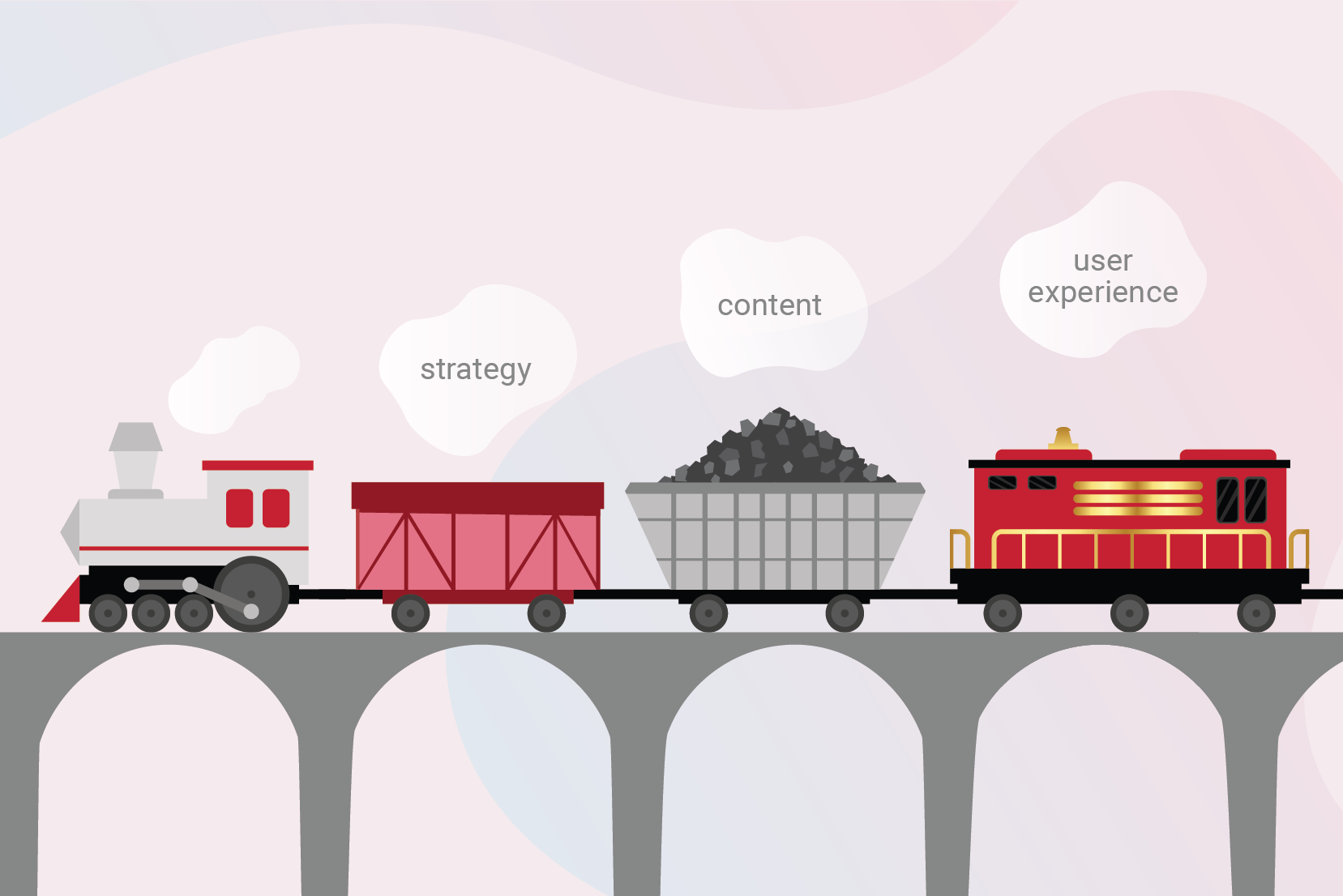
“Many businesses make the mistake of stopping their SEO once they start to see progress. Think of your website’s SEO progress like a train: slow to get moving . . . and once it’s moving, pulling the power won’t immediately stop your progress. But it can over time, and then you’ll have to start all over again.
So, keep the lights on, keep the train powered, and full steam ahead!”
SEO can be a big, gnarly beast of a thing. But if you’re ready to understand the challenge, create a keyword strategy, double down on your content, optimize your user experience, and keep going, you’ll get where you want to be. And remember, our team is here to back you up along the way.